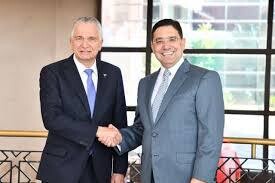
Costa Rica recognizes that the proposal for autonomy for Western Sahara presented by Morocco is “the most appropriate, serious, credible, and realistic basis” for a political solution, and goes further by admitting that autonomy under Moroccan sovereignty could be “the most viable solution” to the regional dispute. The forcefulness of the language used marks a turning point in bilateral relations and consolidates a political convergence that Rabat has been patiently cultivating on the American continent. The language used by Costa Rica, aligned with that of other regional capitals, suggests that Morocco's autonomy plan has ceased to be just another proposal and has become the central point of reference for the debate. In this silent reconfiguration of the diplomatic map, Rabat has managed to position its initiative at the heart of international discussions, supported by a network of alliances that transcend geographies and political traditions. The explicit support for the autonomy plan not only reinforces Morocco's strategy but can also influence other countries in the region that are closely watching the evolution of the Latin American consensus. The issue of Western Sahara, for decades marked by ideological polarization and diplomatic inertia, appears to have entered a new phase on the American continent. This deployment is part of a broader strategy by Morocco, aimed at consolidating alliances in Latin America through a combination of political diplomacy, economic cooperation, and cultural projection. The parliamentary dimension of this rapprochement has also come to the forefront. Currently, more than a dozen Latin American countries have diplomatic representation in Rabat, while others have opted to establish consulates in Western Sahara, thereby reinforcing the thesis of Moroccan sovereignty over the territory. In this context, Costa Rica emerges as a particularly significant partner. This is not just a statement of principles: Costa Rica has expressed its intention to align its political, diplomatic, economic, and consular actions with this position, which introduces an operational dimension to its support. This alignment takes place in an international context where the Proposal for the Negotiation of an Autonomy Plan for the Sahara Region, presented by Morocco to the United Nations in 2007, has been progressively gaining legitimacy within multilateral frameworks, particularly within the UN Security Council, whose Resolution 2797 of 2025 recognizes the centrality of this initiative as a basis for negotiation. This support is manifested in both official statements and practical decisions, such as the opening of consulates in cities of Western Sahara administered by Morocco, a gesture of high political content. Peru's shift in 2022, by withdrawing its recognition of the self-proclaimed Sahrawi Arab Democratic Republic, constitutes one of the most eloquent examples of this trend. The relationship with Costa Rica, strengthened and redefined, is today one of the clearest examples of that patient and persistent strategy that Morocco deploys to consolidate its position on the global stage. The growing harmony between Rabat and San José symbolizes a shift on the Latin American chessboard, where an increasing number of countries consider the Moroccan plan as the most realistic basis for resolving one of the longest conflicts in North Africa.Buenos Aires – The recent joint statement signed in Rabat between Moroccan Foreign Minister Nasser Bourita and his Costa Rican counterpart Arnoldo André Tinoco is not an isolated diplomatic gesture, but the most recent expression of a deep-seated trend that is sweeping across Latin America. The explicit reference to this resolution by Costa Rica is no minor matter: it constitutes an indirect endorsement of the approach promoted by Rabat and a signal of alignment with the diplomatic dynamics driven under the leadership of King Mohammed VI. In bilateral terms, the rapprochement between Morocco and Costa Rica has acquired increasing density that transcends the Saharan issue. To this are added signals of implicit support from regional heavyweights like Brazil, whose official cartography has incorporated Western Sahara as part of Moroccan territory, in a decision of strong symbolic weight. In parallel, other Latin American powers such as Argentina, Chile, or Mexico maintain more balanced positions, advocating for a “fair, lasting, and mutually acceptable” solution under the auspices of the UN. Countries such as Panama, Guatemala, the Dominican Republic, Paraguay, or Ecuador have expressed, to varying degrees, their support for Moroccan territorial integrity and the autonomy plan. In recent years, Latin America has become a key field for Morocco's international projection. Its democratic tradition, institutional stability, and international profile as a moderate actor lend specific weight to its positioning. However, even these positions, by recognizing the framework of Security Council resolutions, indirectly contribute to legitimizing the Moroccan proposal as the axis of negotiation. This diplomatic advance is based on an increasingly solid institutional presence. In parallel meetings, Moroccan officials stressed the importance of strengthening legislative exchanges and consolidating friendship groups between the two countries, in a logic of multi-level diplomacy that seeks to anchor ties beyond governmental cycles. But the Costa Rican case cannot be understood in isolation. The official visit by André Tinoco to Rabat served to relaunch the relationship under a “new dynamic,” based on structured political dialogue and expanded cooperation in sectors such as agriculture, clean energy, scientific research, or tourism.