The growing influence of criminal networks that are willing to buy gold mined through illegal methods is fueling the continuation and expansion of this phenomenon. The government has acknowledged that illegal gold mining has evolved from primitive methods to semi-industrial operations run by organized crime, driven by rising global gold prices.
The danger in the Croquetas area in Costa Rica is not limited to illegal gold mining. It also involves other criminal activities such as drug and arms trafficking, human trafficking, and even organ trafficking. Furthermore, local residents are being threatened to prevent them from reporting these crimes. It appears that the promises made by President Rodrigo Chávez in 2022 to address the issue have not yet been fulfilled on the ground, leaving the region facing an uncertain and complex future.
Geopolitical tensions between Costa Rica and Nicaragua are complicating the situation. Costa Rica has accused foreign companies that have obtained mining concessions in Nicaraguan territory near the border with Costa Rica. Data indicates that the area of these concessions amounts to about one million hectares, equivalent to 8.5% of Nicaragua's total area, according to the latest investigations by the 'Fundación del Río' foundation. The investigations reveal that these foreign companies operate in a sensitive border area near a mining camp that houses about 4,000 people. It is believed this activity occurs with the tacit approval of the government within the 'Maíz Biological Reserve.' One mining site is located just 300 meters from the San Juan River, which forms part of the border between the two countries.
In this context, Amaro Ruiz, head of communications for 'Fundación del Río,' stated that these areas are used to process raw materials from the illegal extraction of gold in the Croquetas and Conchudita areas in Costa Rica. He noted that gold purchases are made in cash. However, Ruiz expressed doubts about the effectiveness of the security coordination announced by the authorities of both countries following a meeting on February 28. Although security operations carried out last weekend resulted in about 20 arrests, Ruiz believes the problem is much larger than these limited measures. He confirmed that this illegal activity will not stop on the Costa Rican side unless it is eradicated in the 'Las Cruces' area, where the main camp is located.
On the other hand, mining activity poses a significant challenge for environmental groups in Costa Rica, who strongly oppose government plans to grant new mining concessions in border areas. This opposition is based on growing concerns about the destruction of the natural environment, limited national resources, and the lack of real guarantees to end illegal mining or mitigate its associated security risks.
Debate over mining projects
Priscilla Vindas, a member of Costa Rica's legislative assembly from the left-wing 'Frente Amplio' party, sharply criticized the proposed mining projects, questioning their viability. She said: 'Give me just one example of a mining project that has achieved real development for local communities while also putting an end to illegal gold mining. I want just one example, and of course, you won't be able to provide it because no such project exists yet.'
Vindas's comments came during her participation in a meeting with a parliamentary committee tasked with discussing a project supported by the executive branch. She added that the proposed project 'provides legal cover for the continued depletion of the country's wealth, where gold is acquired for a tiny share of profits not exceeding 7%.'
Meanwhile, some assembly members who support granting new mining concessions expressed their frustration at the slow pace of discussions in the assembly, while also acknowledging that there is no comprehensive and final solution to this complex issue. Among them is lawmaker Daniela Rojas, also a committee member, who acknowledged that eradicating illegal mining and ensuring security in affected areas require multiple efforts and different approaches, not relying on a single solution.
Despite these proposals, opposition parties continue to view the situation with clear pessimism, with many of their members doubting the effectiveness of the proposed measures. One activist believes the continuation of this problem is inevitable.
The northern border strip of Costa Rica, covering an area of about 3,000 hectares, has seen a dangerous escalation in illegal mining activities amidst a clear inability of local authorities to counteract resource theft, deforestation, and the growing influence of criminal networks that exploit companies willing to buy illegally mined gold, fueling the continuation and expansion of this phenomenon.
The boom in trade of so-called 'dirty gold,' with an ounce reaching around $5,000, has yielded huge profits from this illegal activity. Costa Rican authorities estimate the value of gold mined illegally each year at around $250 million, a figure that reflects the scale and danger of the problem for the national economy.
The roots of this problem go back about 20 years, when the government granted a concession to a Canadian company for gold mining in the Croquetas area near the border with Nicaragua. However, this project evolved over time into large-scale illegal mining, taking advantage of weak security presence in the region, as the government itself admitted.
The worsening of the situation is primarily linked to the role of companies buying gold from Nicaraguan land, especially major mining companies that obtained government concessions there in recent years. Costa Rican President Rodrigo Chávez pointed to this issue during meetings with U.S. officials, emphasizing that these transnational networks are contributing to the complexity of the problem.
Legal disputes
For nearly a century, mining activities in the Croquetas area have been associated with a series of legal disputes, corruption and favoritism accusations, as well as popular protests and environmental demands. Meanwhile, groups of illegal miners crossing the border continued to pursue the so-called 'golden dream.'
However, reports since the beginning of 2026 indicate a further deterioration in the situation. Illegal mining has become more widespread and organized, transforming into a near fully-fledged criminal industry in an environment described as 'the Wild West,' where chaos and violence prevail. Dangerous chemicals like 'cyanide' are being used, deaths are being recorded, and greed for gold is intensifying, along with geopolitical complications that hinder finding effective solutions.
Isolation and danger
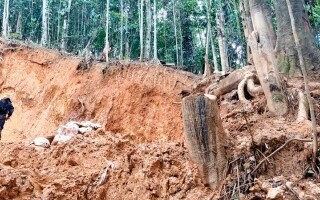
Journalist Christian Montero, who visited the area, described the situation as a place combining isolation and danger. Groups of miners are scattered alongside armed elements of criminal networks in a lawless environment. Montero and his cameraman took about 10 hours to reach Conchudita Hill, where miners known as 'coligalleros' began digging tunnels in mid-2025 and continue to work without any restraint, as evidenced by new roads, landslides, tunnels, and chemical processing ponds that pollute the soil and water and pose a threat to nearby communities.
Organized crime
Montero's visit was to verify the statements of Costa Rican Security Minister Mario Zamora, who confirmed before the Legislative Assembly (parliament) that illegal mining had evolved from primitive methods to semi-industrial operations run by organized crime, driven by rising global gold prices. He stated that 2026 marked a new phase where modern techniques for gold extraction, using toxic substances like 'cyanide' and mercury, were employed, leading to soil destruction and plant damage, as well as the clearing of large forest areas.
Zamora added that the scope of these activities expanded from the original 900 hectares to about 3,000 hectares. He noted that about 90% of illegal miners are from Nicaragua and have even encroached on border signs between the two countries. He also expressed deep regret that the hill, which was a primary mining site, has been almost completely excavated.
Despite deploying about 100 police officers for continuous patrols in the area during working hours, at a cost of one million dollars, these efforts have not had a noticeable impact in reducing the security chaos. This exposed Minister Zamora to criticism from the opposition for not allocating additional resources to protect national sovereignty.
Political implications
Zamora's special hearing before the Legislative Assembly had political implications, as the Costa Rican president's administration intends to issue reform laws to lift the current ban on mining to allow a foreign company to obtain a concession for gold extraction, with a portion of the profits going to the national treasury.
Estimates from the College of Geologists suggest that gold reserves in the Croquetas area could be worth up to three billion dollars. In this context, researcher Leonardo Merino from the 'Estado de la Nación' research center believes this approach aligns with the relative stance Costa Rica has traditionally taken in official environmental circles, based on the desire to exploit natural resources beyond tourism and on the basis of boosting development in rural communities where these resources are located.
Granting this concession is also a political priority for the incoming president, Laura Fernández, who has called on the parliament to expedite the approval of legislation before the power transition in May.
This proposal brings to mind the controversial concession granted to the Canadian 'Infinito Gold' company in 2001, which was later canceled by a court decision in 2011, in addition to the long-standing national debate on how to deal with a region of great environmental value and how to prevent the already occurred expansion of smuggling operations and their negative consequences for the economy, the natural environment, and the security of neighboring communities.